THREE TREES FARM

Home | Our Mission | FAQs | Products | Services
Fun Stuff | Glossary | Beneficial Insects | Growers Friend | Worm-A-Rama
| ** ORDER FORM **
CONTACT US
WORM-A-RAMA
WORM BIN INSTRUCTIONS
1.) Assemble Worm Bin:
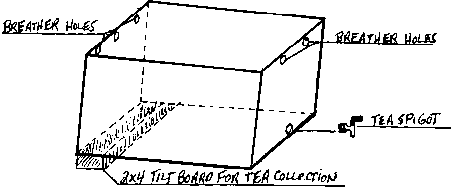
NOTE: TILT WORM BIN TOWARDS VALVE FOR BETTER DRAINAGE
A) Install drain valve parallel to the bottom of the unit. Push in and turn valve clockwise approximately 3 turns after it starts threading. DO NOT over tighten. Tapered thread with Teflon tape will seal. Before moving unit, turn entire valve sideways after installation to prevent breakage. Keep valve opened to facilitate drainage. Manure tea will come out of the valve and should be used as a liquid fertilizer. Best if used immediately. The manure tea will make your potted plants leap out of their pots.
B) The next step requires some resourcefulness. Fill the worm bin up to 3" deep with some type of refuse. Example: composted leaves, grass clippings, vegetable scraps or manure; cow, sheep, horse or rabbit. The yard refuse needs to be composted so it is an appealing food for the worms. Raw yard refuse is not recommended for a NEW worm farm. The Red Wigglers have to be pampered at first, especially in a container. In an outdoor operation(where raised beds are used), the farmer can have a higher degree of error. If we overfeed or overwater our outdoor worm operation, the worms can escape from a temporary life threatening situation. But in a container, the worms cannot escape and therefore may become victims of the improper care and feeding of the farmer.
Many observations should be made at this point. Moisture content of worm bedding or food, temperature, type of food. How green or hot, population of worms. These observations are very important. This could mean the difference between the life and death of your farm.
FEEDING TIME!
The manure should be straw based, not wood. Straw is best for vermiculture(the total environment that the worms live in). The straw or peat moss needs to be soaked overnight so it can be consumed by the worms. This is also true for paper products such as cardboard. The Red Wigglers will eat paper products but the paper has to be soaked in water first. Preparing the food for the Red Wiggler is very easy here in the Northwest, just leave the worm food out in the rain for a few days before giving it to the worms. After soaking the straw in water, wring out the excess moisture. This is only necessary for the container type worm bin. In an outdoor operation, the excess moisture will not be a problem. Earthworms cannot consume DRY food! Chicken manure(a HOT manure) is also a good worm feed but one must exercise caution with HOT manures.
Make sure the manure is composted so it doesn't reheat. Be sure not to over do it. Easy does it on the amount of food. The food needs to be moist so the Red Wigglers can get into it. If the worm bin receives too much water it will be evident through the clear plastic worm bin. Too much feed will suffocate the worms and too much water will drown them. Remember, containerized cultivation is completely reliant on the farmer. When it rains, the earthworms come up for air. They breathe through their skin. The Red Wiggler composting earthworm tends to live and colonize just under the surface of the soil. In this case, manure, food scraps and yard refuse. The Red Wiggler is a manure worm that is found naturally at dairy's and stables. The presence of these creatures is a natural phenomenon. Farmers that deal with manure and leave it in one place long enough, will testify to this fact!
Red Wigglers need manure to stay healthy. After the Red Wigglers have made themselves at home, cafeteria food scraps may be introduced to the worm bed. Whenever we feed our Red Wigglers food scraps, simply sprinkle a thin layer of leaves, lawn cuttings or straw or peat moss over the top. Moisten the worm bed moderately and this will keep the worms working. Remember, the Earthworms are photosensitive so they only work in the dark. Also, don't forget that whatever we feed our Red Wigglers, it has to be moist. Unlike a compost pile, vermiculture should never be stirred or disturbed, if possible. That's the worms work!
The location of the worm bin should be someplace close to the kitchen. Food scraps will be administered regularly. The bin should be kept warm for top performance and high yield. But keep in mind that the worms are photosensitive. Darkness is the best for worms. Example: Under the sink, or on the porch on the way to the compost pile and/or the outdoor worm bin. NOTE: Place one piece of 2x4 wood under the bin, opposite the valve to tilt the entire unit towards the valve. This will help circulate warm air and increase temperature and productivity.
HARVEST TIME
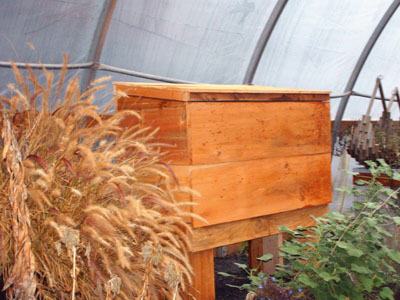 When the Worm bin gets close to the full mark, it's time to harvest the earthworm castings. Use some bait to catch the bait. Mix up a tasty treat for your new friends. Combine some coffee grounds with some fruit slurry in a blender. Water the mixture down so you have enough to sprinkle on the worm beds. Red Wigglers are very attracted to acidic situations. These include: Manures, cannery waste, or silage; and food scraps from the cafeteria. By this time the Red Wigglers should be overcrowded. The Red Wigglers will surface into the food in a few days. Now it's time to separate the red worms from the castings.
The definitive line between the vermicompost and the castings should be obvious. That's why we don't stir up the worm bed; harvesting is made easier by leaving them be! Keep in mind under optimum conditions Red Wigglers multiply exponentially every 7 days at 70 degrees F. The Red Wigglers can reach over a million in population in a little over a months time. This is , of course, under optimum conditions with copious amounts of manure.
Worm castings are a bio-organic fertilizer which is presented as a light crumbly odorless product. It is very rich in enzymes and microorganisms(approx. 2 billion bacteria per gram). It is a plant food that is directly assimilated, rich and balanced, reconstituting and anti-parasitic. The castings stimulate rapid germination and minimize shock during transplanting. Earthworm castings contain humic acid which promotes rapid root development. Great for cuttings, seedlings, germinations and transplants.
KEEP ON WORMING!!
Questions or comments? Call Chris Boissevain at Three Trees Farm (541)942-9033
FOOTNOTE: When ordering Red Worms, Three pounds are recommended for fast results.
Home | Our Mission | FAQs | Products | Services
Fun Stuff | Glossary | Beneficial Insects | Growers Friend | Worm-A-Rama
| ** ORDER FORM **
Our Contact Information:
Three Trees Farm
73470 Abeene Lane
Cottage Grove, Oregon 97424
541-735-0046
(9:00 AM PST to 6:00 PM PST)
CONTACT US
(please leave an evening phone number)
LEGAL NOTICE:
© 1996 - All content developed by Chris Boissevain, owner Three Trees Farm